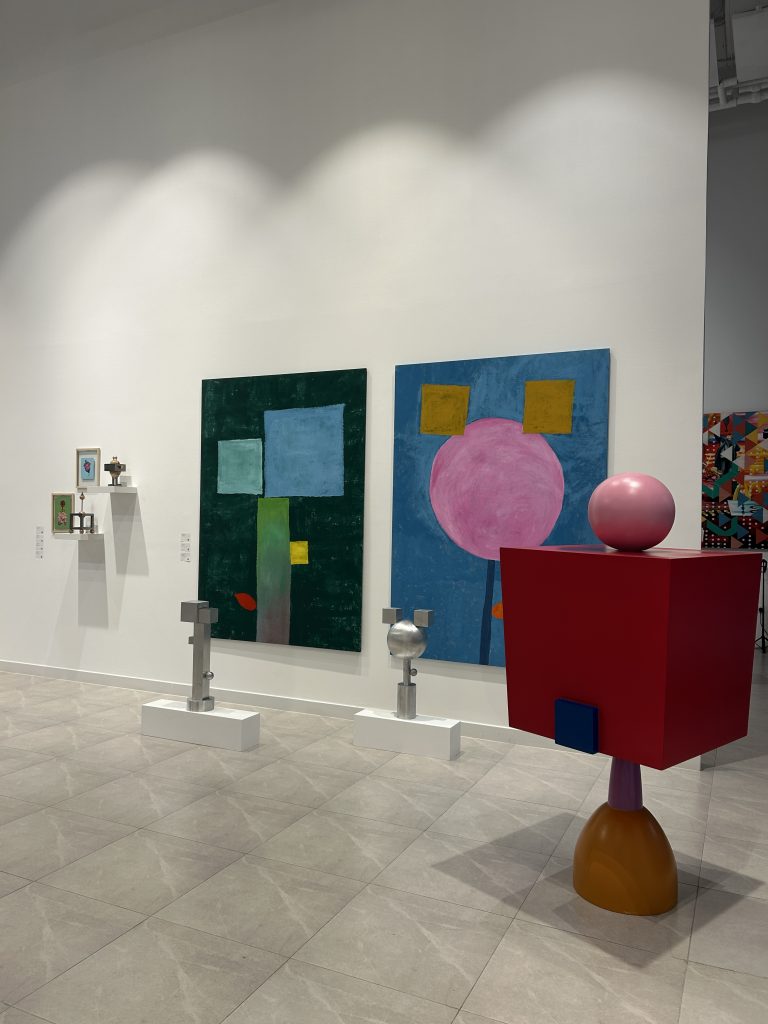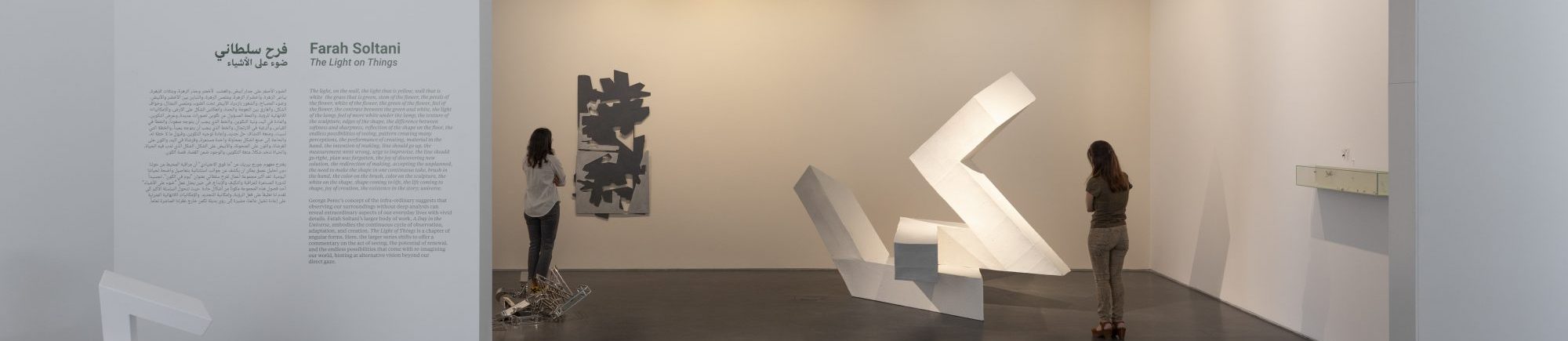
Soltani’s work is driven by a sustained interest in how reality is constructed through attention. By altering familiar forms—sometimes relocating them, sometimes rendering them abstract or imaginary—she repositions the viewer’s relationship to the mundane. What initially appears simple becomes unstable, inviting a slower, more attentive mode of seeing in which the ordinary is revealed as complex and layered.
A central strand of her practice is her engagement with the vegetal world. Plants, particularly leaves and botanical structures, recur as both subject and method. Observed during periods of isolation, especially during the pandemic, these forms became sites of sustained reflection and drawing. In her work, vegetal motifs often appear in states of decay, fragmentation, or transformation, registering time as a visible force. These studies gradually evolve into geometric and minimalist abstractions, translated into sculptural and pictorial forms that retain the memory of organic life while shifting toward reduction and formal clarity.
This tension between the organic and the constructed is reinforced through her use of industrial or synthetic materials such as plastic, paper, and manufactured surfaces. Their juxtaposition with natural forms produces a quiet friction, through which questions of temporality, fragility, and ecological entanglement emerge. Rather than presenting nature as a stable reference point, Soltani’s work positions it as something continuously mediated, observed, and reconstructed.
The Deamplify series crystallizes this approach. Here, Soltani investigates the process of reducing visual forms to their most essential expressions. The works explore how minimal structures behave in space, how they interact with their environment, and how reduction can generate both conceptual clarity and emotional resonance. Inspired in part by Pablo Picasso’s capacity to distill complex subjects into simple, almost childlike forms, the series adopts a similar logic of visual economy—one that treats simplification not as loss, but as transformation. At its core, Deamplify asks how much information is necessary for recognition, and what remains when excess is removed? The resulting works operate at the threshold between representation and abstraction, suggesting that minimal form can function not as limitation, but as a heightened state of attention.
Written by Alexander Burenkov
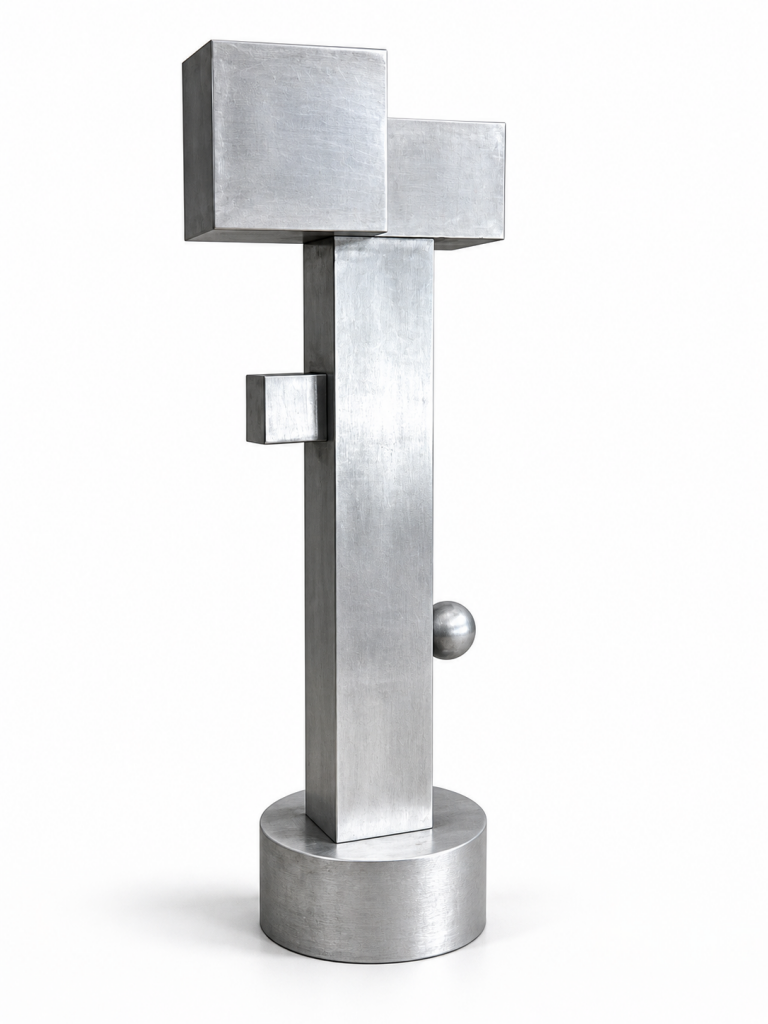
70 H x 18 W x 22 L cm
Aluminum 2026
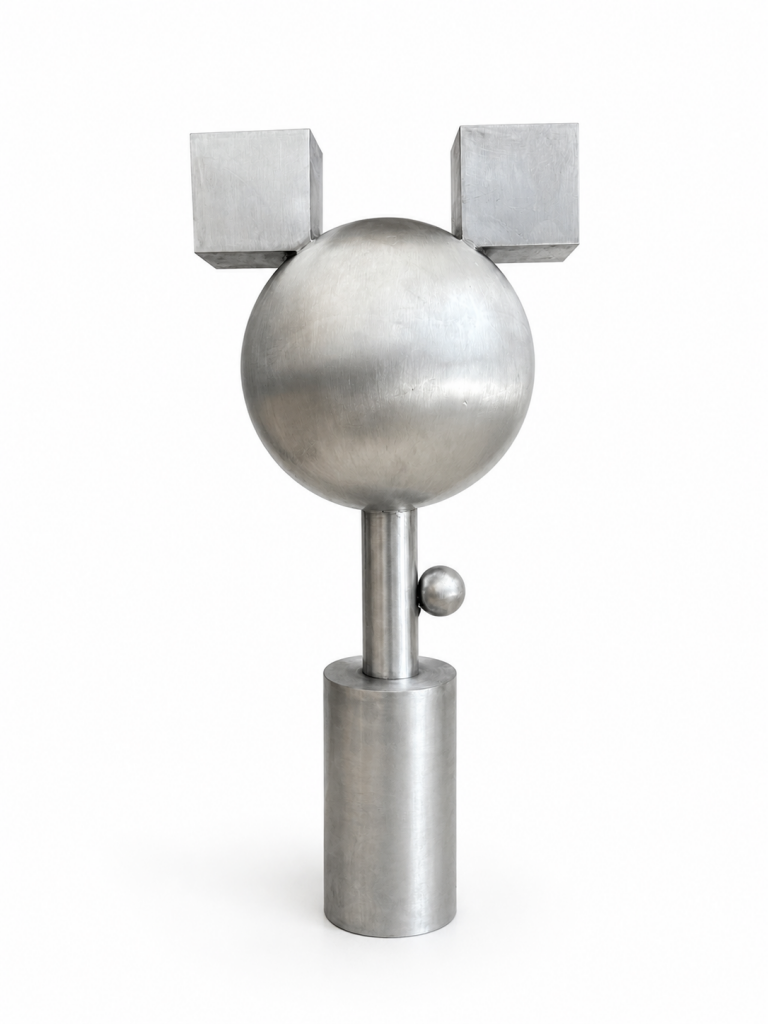
70 H x 49 W x 33 L cm
Aluminum 2026